OccupyCopan
In November 2011, I exhibited for the first time in a contemporary art group show. The group show Projeto Imóvel, also known as OccupyCopan, brought together 28 artists in a 3,500 square meter space on the lower floors of the Copan Building, abandoned for almost two decades. It was conceived and curated by Alessandra Terpins. Fernanda Brenner, part of the production team, would found Pivô in that same space just a few months later.
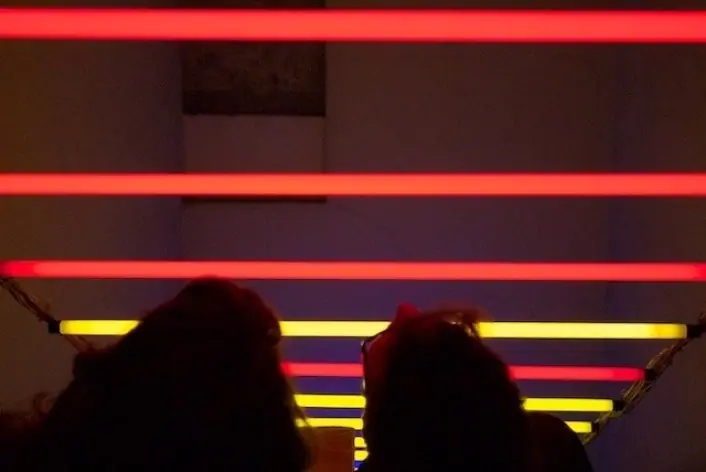
I found a vertical void between two floors where a staircase once existed. I built a sculpture of tubular fluorescent lamps, yellow, blue and red, tensioned by steel cables, spanning the void from one floor to another. The composition was rhythmic: the colors alternated in cadence, like a vertical score of light. No support besides the cables, the lamps were suspended in the air, occupying the void that the architecture had left behind.
I still didn’t know how to articulate what I was doing. Only a year later, visiting Dan Flavin’s exhibition at Mumok in Vienna, I recognized in my own production the territory he had conquered: the fluorescent lamp as medium, light as matter that defines space. The undergraduate thesis I wrote in 2013, LUZCIDADE, starts precisely from this connection, from Moholy-Nagy to Flavin, from Flavin to my luminous interventions in São Paulo. OccupyCopan was the first gesture in this lineage.
Fact sheet
- Status
- REALIZED
- Year
- 2011
- Location
- Copan Building, São Paulo
- Type
- installation
Credits
- Concept
- Felipe Sztutman
- Photography
- Frans Kemper (Vitruvius)
Dossier4
Sculpture of fluorescent lamps suspended by steel cables in the vertical void of the Copan building, the first gesture of the lineage later articulated as LUZCIDADE.
- Number
- 002
- Context
- LUZCIDADE series / vertical intervention
- Series
- LUZCIDADE
- Technique / medium
- fluorescent lamps · steel cable · light in space
Public relations2
Public connections that situate this work inside the archive before the narrative text.
Archive note
The only image of the work located so far, published by Vitruvius magazine (Arquiteturismo 057.02, November 2011).